

Working Near Water? What Canada's Fisheries Act Requires for Sediment Control on In-Water and Shoreline Projects
Working Near Water? What Canada's Fisheries Act Requires for Sediment Control on In-Water and Shoreline Projects
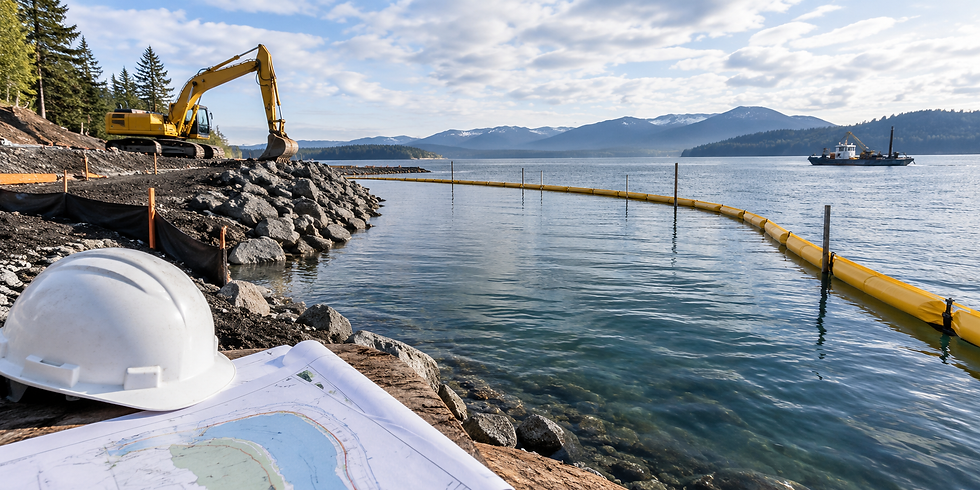
If your project touches a creek, river, lake, or shoreline, sediment control stops being a best practice and becomes a legal obligation. Under Canada's Fisheries Act, letting silt or sediment reach water frequented by fish isn't just an environmental miss, it's a federal offence, and “we did our best” only counts if you can prove it.
Here's what contractors, project managers, and environmental consultants need to know before bidding or breaking ground near water.
The two provisions that matter most:
The HADD prohibition (section 35). No person shall carry on any work, undertaking, or activity that results in the harmful alteration, disruption, or destruction of fish habitat. The modernized Act (in force since August 2019) restored this prohibition in full, it covers all fish and all fish habitat, and “fish habitat” includes not just the water itself but spawning grounds, nursery and rearing areas, food supply areas, and migration routes. Riparian areas your crew is clearing can count.
The deleterious substances prohibition (section 36). It is illegal to deposit, or allow the deposit of — a deleterious substance into water frequented by fish, or anywhere it could enter such water. Two related provisions round this out: section 34.4 prohibits works that cause the death of fish, and section 38 creates a duty to notify authorities of a prohibited deposit (failing to report is its own offence).
The part most contractors miss: sediment counts as a “deleterious substance”
The Act defines a deleterious substance as anything that would degrade water quality so it is, or is likely to become, harmful to fish, fish habitat, or people who use the fish. Courts and regulators apply this broadly, it captures everything from toxic chemicals down to naturally occurring soil sediment. Government erosion-control guidance states it plainly: sediment eroded from a construction or development site is considered a deleterious substance under the Act.
Section 36 is also a strict-liability offence. The Crown doesn't have to prove you intended to pollute. Your defence is due diligence, showing you took all reasonable steps to prevent the deposit. A documented, properly executed sediment control plan is the backbone of that defence. An undocumented one is not.
The DFO pathway: what compliance actually looks like
Fisheries and Oceans Canada runs a “Projects Near Water” framework built on a simple hierarchy:
Avoid. If you can design the work to avoid risks to fish and fish habitat entirely, no DFO review is needed.
Mitigate with codes of practice. DFO publishes interim codes of practice for routine works, including temporary cofferdams and diversion channels, culvert maintenance, and temporary stream crossings. If your project fits a code and you apply all of DFO's standard measures to avoid and mitigate risks, no project review is required.
Request for Review. If the risks can't be managed under a code, or your project isn't covered by one, you submit a Request for Review to DFO's regional Fish and Fish Habitat Protection Program office. DFO assesses the risk of fish death, HADD, and impacts on species at risk, and tells you whether an authorization is needed.
Authorization. Where harm can't be avoided, you apply for a Fisheries Act authorization, with conditions and DFO applies its own hierarchy: avoid, then mitigate, then offset any residual harm (for example, through habitat compensation).
The takeaway for bidding: figure out which rung of this ladder your project sits on before you price the job. Authorization timelines and offset costs change the bid.
What a compliant sediment control plan includes
For in-water or shoreline work, DFO guidance expects a plan that covers, at minimum:
Controls installed before work starts: Not after the first rain. Inspect them regularly, repair as needed, and keep them in place until the ground is stabilized and suspended sediments have settled. Biodegradable materials are preferred; remove non-biodegradables once the site is stable.
Isolation of the work area: temporary cofferdams, diversion channels, or turbidity curtains installed before any in-water activity begins, so sediment never reaches open water in the first place.
Fish salvage: qualified professionals rescue and relocate fish before an isolated workspace is dewatered.
Timing windows in-water and shoreline work must respect regional restricted-activity timing windows that protect spawning and incubation. These are species- and region-specific, and working below the high-water mark triggers them.
Sediment-laden water management pumped or diverted water goes through settling basins or filtration, is held until clear, and is released gradually. Spoil is disposed of and stabilized above the high-water mark.
Monitoring and contingency: watch the watercourse for suspended sediment during work, act on what you see, and have a spill response plan ready. Remember: for spill-response purposes, sediment is a deleterious substance — stop work, report, contain, clean up.
Riparian protection and restoration: keep an undisturbed vegetated buffer between on-land activity and the high-water mark, limit clearing, and reinstate banks and streambeds with native vegetation when the work is done.
Near water vs. in water: know which regime you're in
Working near water (entirely above the high-water mark) is about keeping sediment and runoff out: buffers, erosion and sediment controls installed before disturbance, spoil stabilized above the high-water mark, and weather-aware scheduling. DFO's restricted timing windows generally don't apply.
Working in water (below the high-water mark, or on the shoreline) triggers the full regime: timing windows with no-work periods, mandatory work-area isolation, fish salvage, and a much higher likelihood of needing a Request for Review or a full authorization. Price and schedule accordingly.
One more note: the Fisheries Act is federal, but provinces and municipalities layer their own riparian setback and permitting rules on top. Check those too, a provincial permit is not a defence to a federal charge.
The fines are real.
This isn't theoretical. In November 2025, a Quebec bridge-restoration contractor pleaded guilty to a section 36(3) count after concrete rinse water entered Lac des Deux Montagnes and was fined $650,000. In an Ontario case, the Ministry of Transportation and its contractor were fined $250,000 each after repeated sediment deposits from highway construction destroyed fish habitat — DFO cited “insufficient sediment and erosion control measures.” For corporations, section 36 penalties run up to $6 million for a first offence and $12 million for subsequent offences, and each day a deposit continues counts as a separate offence.
Where BMP fits
Compliance starts with isolation: keeping sediment out of the water in the first place. That's exactly what turbidity curtains do, they enclose the work area so suspended sediment settles inside the curtain instead of drifting into fish habitat. For shoreline and upland portions of the job, silt fence, erosion control blankets, and check dams handle the runoff side.
If you're scoping an in-water or shoreline project and aren't sure which curtain type, depth, or configuration the site needs, our turbidity curtain comparison page walks through the options or reach out and we'll help you spec it.
General information only, not legal advice. When in doubt, talk to DFO early and get your environmental consultant involved before the bid goes in.


